Search This Blog

Showing posts with label columbia games. Show all posts

Saturday, October 27, 2018

What’s in the Box: Pacific Victory 2nd Edition

Pictured: Pacific Victory (Second Edition) by Columbia Games
Earlier this year Columbia Games successfully Kickstarted the second edition of the very popular, but long unavailable, Pacific Victory. This month fans of this classic block game of the Pacific Theater of Operations in World War 2 began receiving their copies. 


As my copy has just arrived as well, now is a good time to unbox this great looking game and show everyone what’s inside. Since I’m a blogger and not a YouTube vlogger, this unboxing is presented via photographs. Nevertheless, it should be clear to see the quality of the components and design. A full review of the game will be given in a future post. 


Happy to see that Columbia kept the first edition cover art by Eric Hotz.


Nothing like a big bag of blocks to sticker! 132 blue, orange, brown and yellow blocks.  Pictured here are the 24mm blocks offered as an upgrade for Pacific Victory.


The optional mounted map board is an available option that is considerably thicker than the standard card stock 25.5 x 33  map pictured below but both are beautifully illustrated and significantly larger than the first edition. 


Second edition labels feature artwork by veteran illustrator Christopher Moeller. 


Rule book is consistent with Columbia’s normal quality: well organized, featuring  examples of game play and under 15 pages of actual rules. Several scenarios are also included for shorter campaigns or the full WW2 PTO scenario. Back cover also lists the Sequence of Play and Unit Data and order of combat battle.


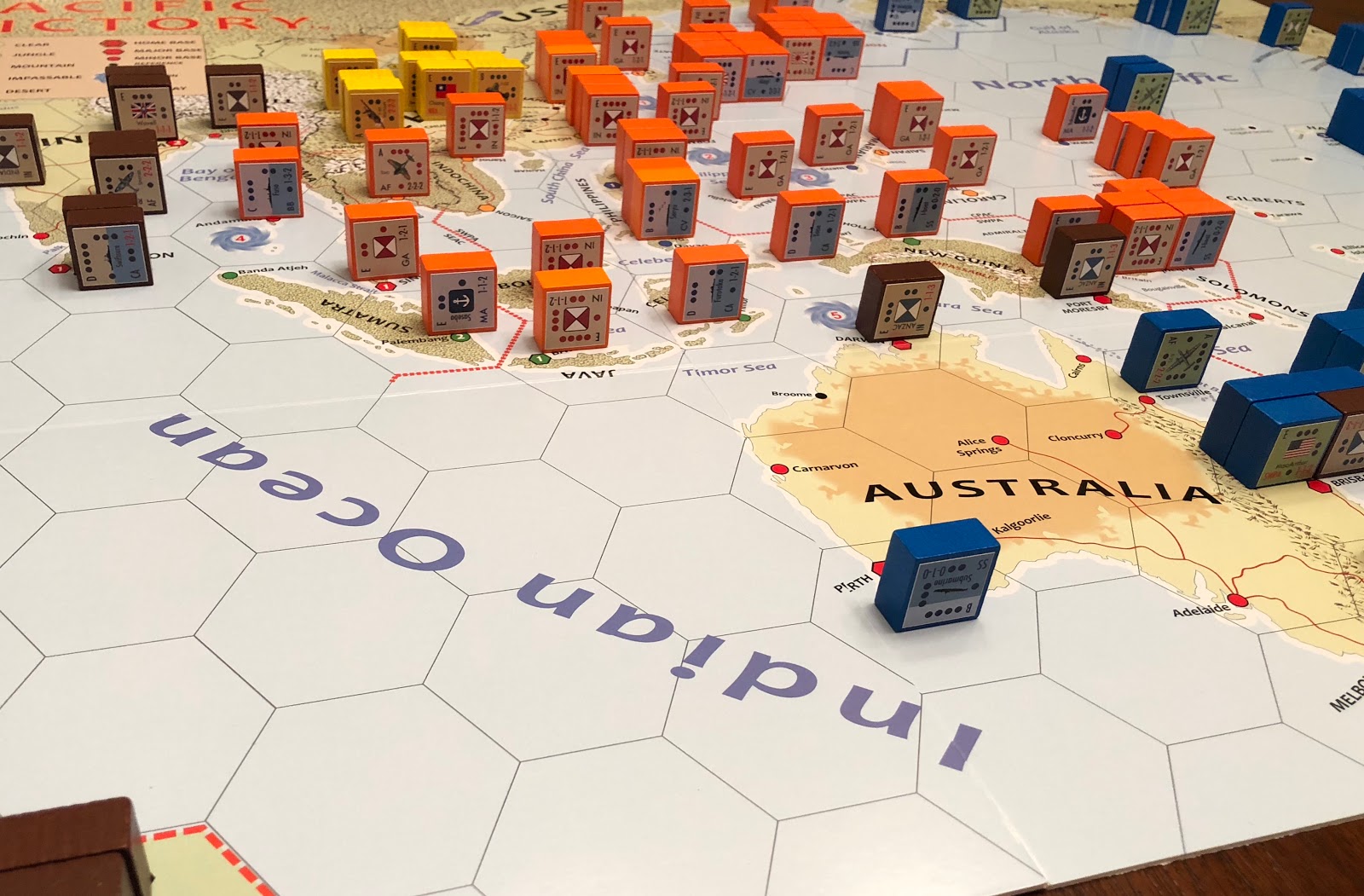
All 132 blocks labeled!  From left to right: Japanese, Chinese, British, Indian, Anzac and U.S. forces.


Board set up for the  June 1942 scenario!


Plenty of room for 24mm blocks if those are your preference. 
Columbia Games even makes a cameo appearance up in Washington. 


Friday, October 12, 2018

Exclusive: Columbia’s Next Kickstarter is Another Victory for Fans

Pictured: Victory: The Blocks of War by Columbia Games
Fresh on the heels of their successful Kickstarter campaign for the second edition of Pacific Victory, Columbia Games is set to announce next week another big victory for their fans. Victory: The Blocks of War, a classic Columbia title which (in many ways) set the stage for both Pacific Victory and Wizard Kings (in its design and concept), is about to get even better.

While the base game for Victory is not changing, I’m hearing that it will be offered at a reduced price as part of the Kickstarter campaign. Even more exciting, however, is the news that this WW2 era strategic game will be seeing the re-release of the Elite Blocksets, with their array of torpedo bombers, engineers, supply units, and more. Additional forces will be a part of this Kickstarter as yellow and brown blocks are set to be added to the Victory line up as well.

For those not familiar with the game, Victory is a simple to learn and simple to teach World War 2 era game of coordinated combat featuring land, air and sea units played on geomorphic maps, 4 of which are included in the base game. Like Columbia’s Wizard Kings, Victory: The Blocks of War is a system as much as it is a game. It also serves as a great introduction to war gaming due to its fast pace and brief rules set.

More to come about this once the campaign launches...  

Look at all those blocks from the base set!


Saturday, July 14, 2018

How Block Games Get the Balance Right

Pictured: Hammer of the Scots by Columbia Games

The English Oxford Dictionary defines a game as “an activity that one engages in for amusement or fun; a form of competitive activity or sport played according to rules.”

While often depicting epic battles and legendary military campaigns, block wargames do so without foregoing this basic tenet of gaming: it should be fun. But since block games are also great representations of historic conflicts, there is still a necessary level of complexity inherent in any simulation of war. 

From the challenge of maintaining supply lines, to the unpredictability of combat and unit cohesion, to the difficulty of terrain factors upon troop movement, realism is a key component of any solid war game design. However, a good block war game effectively incorporates these various challenges without foregoing ease of play. After all, it is still a game first and foremost. As Columbia Games notes at their website:

Columbia block games are fast-playing, easy to learn, and designed to be played and played and played, with mounting interest every time...elegant designs provides fog of war and step-reduction with no muss or fuss.

Simply put, block wargames get the balance right.

There are some who have historically sought to differentiate between combat simulations and war games. Providing a solid rebuttal to this argument within a BoardGameGeek forum ten years ago, veteran game designer Richard Berg explained:    

ALL games that purport to show history are simulations. Simulations - which are a common and key tool in many industries - allow the players to recreate what happened by providing as many of the factors that were present as possible (or as the designers desire) and, even more important, what COULD have happened, given different uses of those factors. 
In designing games that are simulations, the key is the FOCUS . . .what the Designer wants the players to concentrate on and use. If that designer wants the players to focus on how to "win" without giving him a great deal of detail, then you tend to have what...folks call "games"... 

From playing cards used for move and supply points, to dice rolls for combat resolution, block games (both by their components and design) give players the basic feel of a classic boardgame. Add to this the wood blocks themselves, particularly the larger 24mm wooden blocks found in games such as Julius Caesar and Hammer of the Scots by Columbia Games, and you have a solid game with popular appeal, often even crossover appeal.  

Pictured: Julius Caesar by Columbia Games
    
Pictured: Cards from Hammer of the Scots by Columbia Games

While some games may be asymmetrical in how they play, a good balanced game should still provide both opponents an opportunity to win, even when the odds are stacked against one because of the actual historical limitations. However, this nod to realism by no means sacrifices enjoyment. Rather, the disadvantaged player must simply rely upon strategy and tactics, and some good dice rolls hopefully, in order to achieve victory! 

Wooden blocks. Dice and cards. Low complexity rules explained in less than ten pages. Games which clock in at only 2-3 hours total. It is this emphasis on fast-play and fun components which best illustrates how block games get the balance right. After all, these combat simulations are ultimately games meant to be played and enjoyed.


Photo credit: Brian Williams 


Tuesday, June 26, 2018

Wizard Kings: When Block War Game Meets Fantasy RPG

Photo: Wizard Kings 2nd Edition by Columbia Games

What happens when you combine the theme and diversity of a fantasy RPG with the game mechanics and elegance of a block war game? You get Wizard Kings, Columbia Games unique fantasy-based block game (1st Ed. published in 2000, 2nd Ed. in 2006). From Columbia’s website:
Wizard Kings is an exciting fantasy battle game with armies of elves, dwarves, orcs, undead, and three human armies (feudal, barbarian, amazon). Players customize their armies and fight for control of strategic cities and terrain on geomorphic maps. 
The base set for the game includes:
  • 4 geomorphic maps which connect in hundreds of different ways. 
  • 7 Armies: Elves, Orcs, Dwarves, Undead, Barbarians, Feudals, Amazons. Base game comes with an assortment of all armies.
  • Wizard Kings Rules     
  • 4 dice     


Game turns are standard fare for those already familiar with other block games. They are made up of the following four phases: 
  • Initiative Phase 
  • Move Phase
  • Combat Phase
  • Build Phase
The game itself is fast-paced, with shorter scenarios often lasting only 10 turns and requiring about an hour to complete. There is also a solitaire scenario included in the base set, though the game is designed for 2-7 players.        


Wizard Kings should appeal to both fantasy RPG fans as well as block war gamers. With its armies of orcs, elves, and dwarves (to name just three), the game captures the spirit of Tolkien’s Middle Earth, or possibly even Chainmail, Gary Gygax’s miniatures & fantasy precursor to Dungeons & Dragons. 

However, Wizard Kings still employs the tried and true Columbia block system for combat with its step losses, combat ratings, fog of war, and dice rolls for resolving battles. Additionally, each army is equipped with their own unique Wizard, capable of spellcasting in either the Move or Combat phase. 

Wizard Kings introduces players to an entertaining game system, but one which also has great versatility and replayability thanks in part to expansion sets containing 21 additional blocks each. While the base set contains 4 geomorphic maps which allow for mixing and matching and customizing scenarios, Columbia Games also sells three additional map packs with 4 maps each to further increase versatility.  


At this point I have only tried a few basic two player scenarios, both of which are available in the 8 page rule book. Each one has been outstanding so far. There are real strategic decisions to be made: coordinating movement and attacks; use of build points to either strengthen existing blocks or to introduce new ones onto the board; when (and how best) to use your wizard, as each spell cast also results in at least one step loss; and how to maneuver across the geomorphic map(s) with all of their terrain effects, stacking limits and hexside limitations.  

After only a few games in and this has already become my son’s favorite block war game. The theme is perfect to capture his young imagination, aided by the quality of the components, particularly the outstanding block label art and detailed maps. Wizard Kings is a game that will no doubt get a great deal of table time in our house.  


Photo credit: Brian Williams 


Tuesday, May 29, 2018

Why Hammer of the Scots is Still a Great Block Game


In 1995 Mel Gibson released Braveheart, Hollywood’s take on the legendary Scottish warrior William Wallace (1270-1305 AD). The movie would go on to make over $200 million at the box office and earn 10 Academy Award nominations, eventually winning 5, including Oscars for Best Picture and Best Director for Gibson.  

In 2002 Columbia Games released their version of the Scottish Wars of Independence, Hammer of the Scots. Over 15 years later, Hammer is still regarded by many gamers as one of Columbia’s very best, and one of the most popular block games on the market. The secret of its ongoing success can be attributed to several factors.  

First, Hammer of the Scots tells a great story. With so many games on the market to choose from, many featuring similar mechanics, a compelling theme can often make or break a game. In the case of HotS, the history and theme is beautifully captured, both through its components and through game play.          


Columbia broke out the “big guns” for HotS, treating fans to their 24mm blocks. Anyone who has played a game with these bigger blocks knows how appealing they are on the board. Even more importantly, the labels for the 56 blocks beautifully capture the Scottish nobles heraldic arms, as well as English knights, archers, infantry, and even Wallace  himself. Add to that a deck of 25 illustrated movement and event cards, and an  outstanding map designed by artist Karim Chakroun, and you have a game that just looks good on your table.                      


The game itself was designed by Tom Dalgliesh and Jerry Taylor, introducing a formula that would later appear in such popular offerings as Crusader Rex and Julius Caesar. Game turns consist of the following: Card Phase, Move Phase, Battle Phase, and Winter. Cards determine initiative and movement points per turn, with 5 event cards in the mix to capture the unexpected element of war.           

Since this is a block game, fog of war and step reduction are present. Blocks in HotS each have a corresponding combat rating, which is indicated by a letter and number, such as A1 or B2. The letter determines when a block attacks. All A blocks attack first, then all B blocks, then all C blocks. The number indicates the maximum roll that will score a hit. This elegant feature allows for the fighting prowess of Wallace’s forces (A3) to be simulated without burdening the players with excessive rules or charts to reference. It keeps the learning curve short and the game play fast.      


Hammer of the Scots is not a hard game to learn. It’s also a simple game to introduce to someone new. However, it’s not an easy game to win. In the Braveheart scenario, which is what I usually play, the English and the Scots each face their own unique paths to victory. 

In addition, HotS contains a neat mechanic in which Scottish nobles switch their loyalty when they are eliminated in battle. The game includes double blocks for nearly all nobles, allowing for them to play for either the English (red blocks) or Scottish (blue blocks) at any given moment. By the end of a 2-3 hour game a noble might very well have flipped their allegiance back and forth several times. The object of the game is to control a majority of Nobles at the end of the scenario. There are also several sudden death conditions for victory too.       

If there is such a thing as the quintessential block war game, Hammer of the Scots might just be it. The component quality is there, the theme compelling, and the game play elegant and easy without sacrificing strategic depth. If it’s been awhile since you’ve played Hammer, it might be time for you to get this classic back on the table.

Photo credit: Brian Williams   

Monday, April 30, 2018

Combat Infantry: A WW2 Squad Level Game Worth Adding to Your Shelf

Pictured: Combat Infantry, WestFront 1944-45 by Columbia Games 

“Combat Infantry” was a badge awarded to U.S infantrymen who participated in combat under hostile fire. It’s also a new, fast-paced, World War 2 squad level block game from Columbia Games. From the publisher:
“You command a German or American infantry battalion, composed of three infantry companies and attached heavy weapons including mortars and tanks. Innovative and interactive rules for Fire Combat, Assaults, Morale, and Leaders make this game sophisticated, yet very playable.”   
The game is comprised of the following components, all reflecting the usual quality people have come to expect from Columbia:  
  • 2 color geomorphic maps (16.5’’ x 22” each)
  • Blocks: 66 green, 66 black 
  • 22 yellow wooden markers 
  • Unit Label sheet (1)
  • 6 scenarios 
  • 4 x d10 dice    
What’s best about Combat Infantry is that it accomplishes what it sets out to do: achieve a level of depth-of sophistication-while never sacrificing playability. What it also manages to do in the process is to give gamers a new squad level WW2 tactical game worth adding to their shelf. Here’s why:         

Those Wooden Blocks            

Because Combat Infantry is played with blocks instead of counters or miniatures, it provides two features which add to the realism of gameplay: Fog of war and Step Losses. These upright blocks, labels facing the owner, help to capture the essence of WW2 tactical combat. As is the case with other block games, opponents experience the risk of not knowing which enemy units they will encounter in battle, or how strong they might be.                     


The Scale of the Game 

Combat Infantry includes units for one American and one German Infantry Battalion, as they were on the Western Front in 1944-45. As noted by Columbia, “This was considered the smallest force capable of attacking or defending major objectives.”   

Most blocks represent rifle squads of only 9-12 men, approximately 3 men per step. Machine guns, mortar teams, and other heavy weapons are teams of 2-3 men per step. Tanks & artillery are individual crews and vehicles. Compare this with games such as Bobby Lee or Napoléon where infantry blocks are at the brigade level, each step representing approximately 3,000 men. Additionally, each hex in Combat Infantry depicts 100 meters.          


Pictured: Solitaire game of Combat Infantry 


The Structure of Gameplay

Unlike other WW2 games, there are no cards or Combat tables to consult. Movement and battle is generated from command units, either by Company Headquarters (CHQs) or Platoon HQs (PHQs). Additionally, leadership rules require players to maintain platoon integrity (e.g. Company C has platoons C1, C2, and C3, each with their own rifle squads and heavy weapons).     

Game turns in Combat Infantry are divided into 8 player turns (4 each), comprised of the following:   
  • HQ Command, 1 per Company per player turn.
  • Commanded units can either Rally, Fire, conduct Special Action (blow up a bridge, etc.), Fire at enemy units in another hex, Move (limited by a block’s movement points & terrain effects), and HQ Action. 
  • Assault: resolve any and all battles from direct movement into an enemy controlled hex.         
After each player has conducted 4 turns (8 total) the Game Turn ends the next one begins. There is real tactical depth within this format. Players decide which units to activate per player turn, cognizant of terrain restrictions, possible unit limitations, and (often) unaware of the enemy units before them.             


Replayability 

Combat Infantry provides players with 6 initial scenarios which recreate American and German firefights in the Normandy campaign. Though not based on specific historical battles, they do a good job of simulating squad level fighting in the weeks and months following D-Day. The scenarios range from 4-8 game turns and take anywhere from 2-4 hours to play. Scenario 6 (Last Stand) makes for an excellent introduction to the game. With only 5 turns and 20 blocks per side, it plays fast and benefits from a low block count. The diversity and scope of these scenarios, with the expectation of more to come from the publisher and their fans, means great replayability for Combat Infantry.  


Is Combat Infantry for you?   

If you are looking for a fast paced WW2 squad level game with strategic depth, Combat Infantry won’t disappoint. I would like to make one suggestion and one observation while wholeheartedly recommending Combat Infantry: 

First, play through it several times (and I would suggest several times with scenario W6) before making up your mind about Combat Infantry. I have found my appreciation of the game increasing significantly with each additional play. The pace of the game continues to pick up as well, something that is important to me.    

Second, make sure you seek out Combat Infantry forums at BoardGameGeek and on Facebook. While the rules are generally well written, I have found myself confused at times about a few (relatively simple) elements of play. Thankfully I’m apparently not the only one. Columbia Games has even uploaded an FAQs at their site.  

Lastly, if you like the game, go review it at BGG. I’m a little surprised by the limited number of ratings it has. This is a well conceived game and it deserves a bigger following than it currently has. 

Photo credit: Brian Williams 

Monday, March 26, 2018

3 Things to Look for in a Good Introductory Block War Game

Pictured: Julius Caesar by Columbia Games (2010)


On several occasions of late the question has been asked, which block war game is the best introduction to the genre? While opinions abound and answers inevitably vary depending upon who you ask, I would argue that there are three important things to look for in a good introductory block game. 

Low Block Count

While veteran gamers may enjoy the challenge presented by a game which spans an entire continent and utilizes a high number of blocks (several hundred in some cases), for the purpose of introducing someone to block war games, remember the old axiom: less is more. 

Fewer blocks (25-30 per player) means fewer decisions and quicker turns, resulting in less time invested overall, and therefore a greater opportunity to appreciate the mechanics and flow of the game itself. Don’t be fooled, however; strategy and tactics are not compromised with less blocks. On the contrary, every decision made is of greater importance as the loss of one battle (and a few blocks) could change the momentum of the entire war. 

Ease of Movement 

Nothing can slow a game down like the movement restrictions caused by terrain on a mapboard. While veterans of block games may appreciate the strategic challenges faced with such terrain effects as rivers, hills, woods, and marshes, the new player may find it all a bit daunting. Great introductory games find ways to introduce movement restrictions without slowing down play or requiring constant trips back to the rules book.  

Point to point games, such as Julius Caesar by Columbia Games, simulate movement restrictions by limiting the maximum number of blocks that can move on a road. In the case of Caesar, a maximum of 4 blocks can travel along a major road (denoted by a solid line), or 2 blocks by minor road (dotted lines). Through this simple game mechanic the need for strategic planning is maintained without forgoing ease of play, which is vital for an introductory game. Similar variants of this can also be found in other Columbia games such as their classic War of 1812, and Shenandoah: Jackson’s Valley Campaign.

An Appealing Theme

Last but not least, a game is supposed to be fun! In historical wargames, find a theme that not only sounds interesting, but that also appeals to you. When introducing someone to block wargames, look for an epic battle, a classic campaign, or a legendary leader to stoke interest in the hobby. Julius Caesar crossing the Rubicon to kick off the Roman Civil War; “Braveheart” William Wallace leading the Scots in their War for Independence from England; this is (literally) the stuff great movies are made of! A compelling theme can help persuade a friend to sit down and give these wooden blocks a shot. 

No doubt there are many other things which help to make a good introductory game great. These three are not meant to be an exhaustive list but rather a simple guidepost for those fans who are looking to introduce others to the wonderful world of block war games.


Photo credit: Brian Williams 

Sunday, March 18, 2018

Photopost: SHILOH, April 1862


In the past I have discussed why block war games teach history so well. I was reminded of this recently when simultaneously undertaking both a book and a game about the Battle of Shiloh.  

Fought over two bloody days near Shiloh, Tennessee (April 6-7, 1862), this famous battle of the Civil War has interested and horrified Americans for over 150 years. It is also known for moments of bravery and slaughter like few had seen before. Indeed, the two days of Shiloh saw more casualties than all other previous wars in American history combined up to that time. 

From the Civil War Trust, a brief overview of the battle itself:
On the morning of April 6, 1862, 40,000 Confederate soldiers under the command of Gen. Albert Sidney Johnston poured out of the nearby woods and struck the encamped divisions of Union soldiers occupying ground near Pittsburg Landing on the Tennessee River. The overpowering Confederate attack drove the unprepared Federal soldiers from their camps and threatened to overwhelm Maj. Gen. Ulysses S. Grant’s entire Army of the Tennessee. Some Federals made determined stands, and by afternoon, had established a battle line at a sunken road, known as the “Hornet's Nest.” Repeated Rebel attacks failed to carry the Hornet's Nest, but massed Union artillery helped to turn the tide as Confederates surrounded the Union troops and captured, killed, or wounded many of them. During the first day’s fighting, Johnston was mortally wounded and was replaced by Gen. Pierre G.T. Beauregard. Fighting continued until after dark, but the Union line held. By the next morning, the Federals had been reinforced by the Army of the Ohio under Maj. Gen. Don Carlos Buell and numbered about 54,000 men, outnumbering Beauregard’s army of around 30,000. Grant launched a counteroffensive along the entire line, overpowering the weakened Confederate forces and driving Beauregard’s army from the field. The Confederate defeat ended any hopes of blocking the Union advance into northern Mississippi.            
Shiloh began to take form for me through an excellent book by professor James Lee McDonough, Shiloh: In Hell Before Night (Univ. of Tenn. Press, 1977). Considered by many to be the quintessential short read on the battle, I was fascinated to tackle a subject which I knew so little about. The book did not disappoint. 

While I quickly learned just how bloody, chaotic, heroic and tragic Shiloh truly was (thanks to the thorough research of Prof. McDonough), I struggled at times to conceptualize the battle itself. Maps were helpful, but I wasn’t really seeing Johnston’s Army of the West march up the Pittsburgh and Corinth Roads, right to the very encampment of Sherman’s men around Shiloh Church. Likewise, the Union stand along the sunken road at the “Hornet’s Nest”, under the leadership of Prentiss & Hurlbut, was known without being truly grasped.  

Enter Shiloh: April 1862 by Columbia Games (2010). Intrigued by McDonough’s history of the battle, I picked up a copy of Columbia’s under appreciated game (which is part of their Great Battles series). Now I was in business!  


There it was: the Corinth Road, Shiloh Church, the immediate disadvantage of the Union troops on day one, the terrain advantages found at the Hornet’s Nest and Hell’s Hollow, Pittsburgh Landing along the Tennessee River, and the eventual arrival of General Lew Wallace’s “lost” Brigade. All was there to see. Through 100 wooden blocks on a board I was seeing bloody Shiloh in a way that a book alone could not show me. From the pages of McDonough’s book to the mapboard of Columbia’s game, two days in April 1862 came to life for me, replete with all of the tension and ramifications of that epic encounter. 

As someone with a degree in history and a love for block games, I couldn’t have asked for a better education on Shiloh than this. 


Photo credit: Brian Williams 

What’s in the Box: Pacific Victory 2nd Edition

Pictured: Pacific Victory (Second Edition) by Columbia Games Earlier this year Columbia Games successfully Kickstarted the second edit...